
How Climate Solutions Actually Scale: Recent lessons from building Living Carbon
There are roughly 100 million acres of degraded land in the United States:1 former minelands, abandoned farms, land that has been written off. Much more of it could be restored and returned to productive use. Yet most of this land will sit idle for decades, because restoring land at scale requires expertise across many disciplines and a platform that can bring it all together. This is what we’re been building at Living Carbon.
When most people imagine climate solutions, they picture a single breakthrough. In practice, building a climate company looks very different. It’s about getting many pieces to work together at once: science, land, financing, supply chains, and long-term buyers.
Six years into building Living Carbon, I’ve learned that getting those pieces to line up reliably and repeatedly is the real work.
The Platform
Today Living Carbon is a climate technology company that develops its own forestry projects. Our north star is simple: maximize the tons of carbon removed or reduced per acre per year.
We source the land using proprietary tooling, design the forest management plan, secure buyer contracts, and develop a robust supply of seedlings. Think of us as the general contractor who also owns the toolkit. As the market matures, we can license that technology broadly. But right now, we’re focused on deploying it ourselves.
We made a structural decision early on that shapes everything about how we scale. We don’t own nurseries. We don’t execute site prep or conduct planting ourselves. That is deliberate. Our parent company stays capital-light. Investors fund R&D and new business lines. Project-level financing covers the capital-intensive fieldwork. That separation means we scale deployment off the balance sheet. Our investors aren’t funding tractors and seedlings. They’re funding the platform, expertise, and technology that make the whole system expand.
Carbon Removal
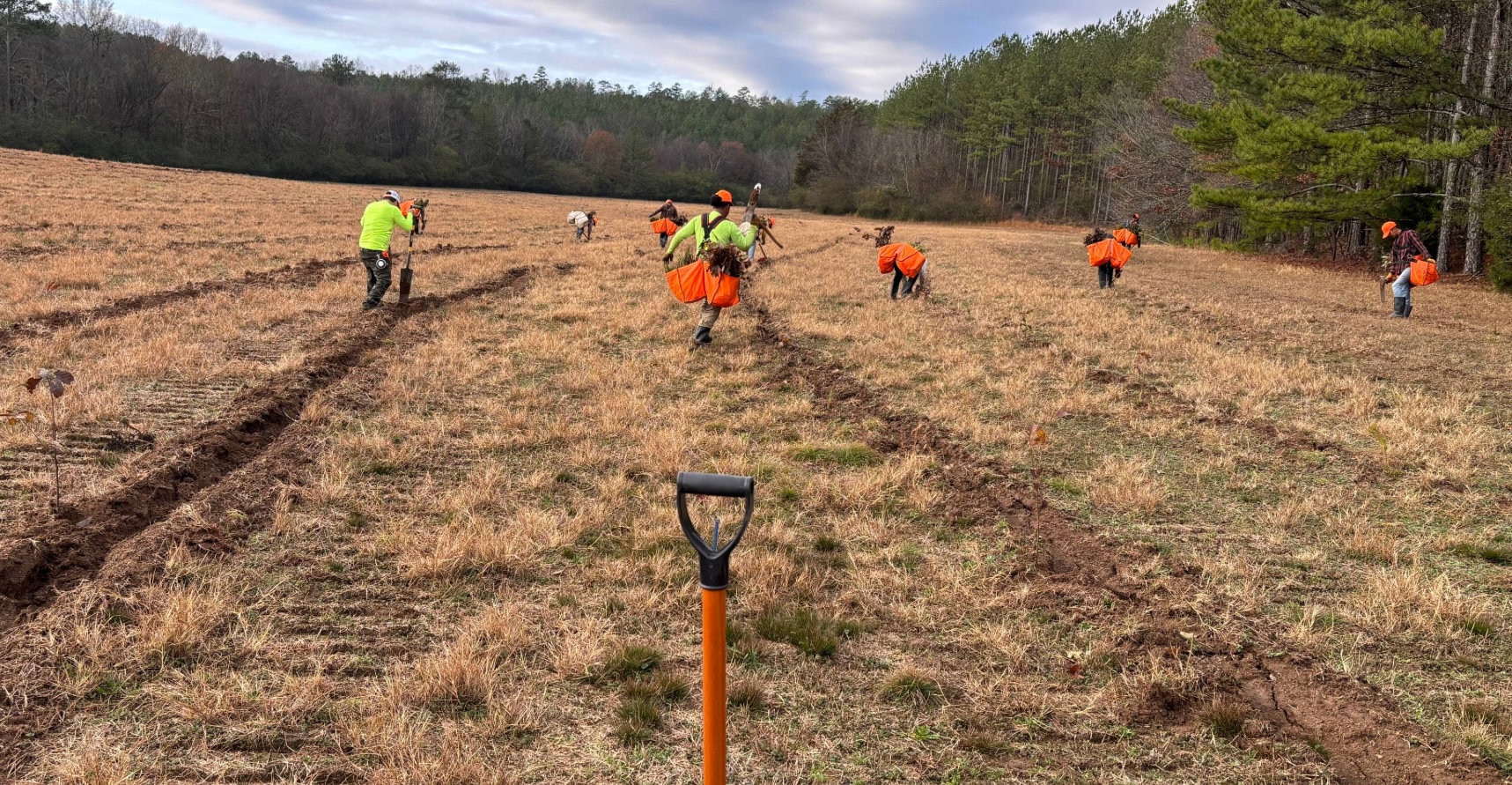
We're developing high-quality reforestation projects on former minelands and abandoned agricultural land, places that would not recover on their own. We plant native species selected for carbon sequestration and ecosystem restoration, and we work with world-class carbon buyers to turn that into contracted, verified carbon removal.
Our current project is set to remove 5.3 million tons of CO2, enough to offset the annual emissions from powering over 600,000 American homes, with partners including Microsoft. This business is scaling, and we have major milestones ahead that we’ll be sharing soon.
Here is why the opportunity is so large: we are not competing with food production or existing forestry operations. We are restoring land that no one else wants and creating economic value for the communities around it. Many of these same communities are where new data centers are being built. Supporting efforts to clean up the legacy of coal and fossil fuel extraction helps pave the way for what comes next.
Biomass
Building our carbon removal business taught us something important: the operational capability to assemble complex environmental asset projects is itself valuable and transferable. That realization is why we are expanding into biomass.
We’re using this platform, and the expertise we gained planting on low-quality land, to develop separate biomass projects to supply sustainable feedstock. Over the past several years, we’ve developed a precision breeding platform for trees that accelerates changes which could have occurred naturally or through traditional breeding, with the goal of improving yield per acre. Our biomass business involves purpose-grown tree crops that stand to benefit from the same yield improvements that have transformed crops like rice and corn.
This work is still in development and is a separate business from our carbon removal projects, developed on separate land, serving different buyers with different needs.
The demand signal is not speculative. Regulatory mandates and government targets are already in place or taking effect shortly across multiple international markets for renewable biological feedstock, from sustainable aviation fuel to dispatchable bioenergy to industrial heat. These are legal requirements. The industries subject to them need supply at scale, and they need it now.
If you spend enough time talking to industrial buyers in energy and aviation, a clear pattern emerges. They need feedstock that is reliable, scalable, and close to their facilities. And they need long-term supply contracts to finance facility construction. We are building to enable that.
On the technology side: some approaches to improving biomass yield, like genetic modification, are useful for proof-of-concept but face long timelines and regulatory uncertainty. We focus exclusively on precision breeding using transgene-free methods. We also engage in partnerships to access elite genetics and biomass data. This gives us a simpler process, broader market support, and the ability to sign the large-scale contracts that shape our business today.
Biomass draws on the same operational playbook as carbon. Now we’re replicating that playbook for biomass, and the market opportunity is significantly larger.
How We Think About Building
A few principles and lessons learned that have shaped how we operate:
Build for the buyer, not the whitepaper. The most exciting science in the world doesn’t matter if it doesn’t fit within how your buyers actually procure, get approval, and finance. We’ve spent as much time understanding how public companies buy as we have on our tree genetics.
Regulatory strategy is product strategy. In biotech, your regulatory pathway determines your speed to market, your addressable market, and your cost structure. We chose precision breeding for biomass because the regulatory path is clearer and faster globally, and because international mandates are creating buyer demand right now.
The operational puzzle is part of the moat. A lot of climate companies over-index on technology and under-index on whether the business is actually financeable and scalable. The real barrier isn’t the IP. It’s the ability to assemble all the pieces, reliably and at scale, so that someone will actually contract against your future delivery.
Structure the capital to match the ambition. In deep tech, how you structure the capital stack matters as much as the product. We chose to build a platform and enabling technology rather than become a landowner or nursery operator. That means we scale through both TopCo equity and project financing instead of overly diluting our equity investors every time we plant more acres.
Your first market reveals the second one. We built Living Carbon around carbon removal. The operational muscle we developed doing that work is what made biomass possible. We found product-market fit for biomass immediately, at a scale much larger and faster than carbon. We would not have identified this opportunity without going deep on environmental assets first.
What Comes Next
In 2026, we are focused on delivering. We are scaling our carbon removal projects with contracted buyers who represent some of the most credible demand in the market. We are advancing our biomass business to first deployments. And we are proving that the operational model we are building works across asset classes and geographies.
But the vision is bigger than any single year. At a much bigger scale, Living Carbon’s projects have the potential to offset real percentages of total U.S. annual emissions while restoring hundreds of thousands of acres that most people have given up on.
Imagine a world where degraded land doesn’t sit idle for decades. Where a former mine site in Appalachia can be reforested within years, removing carbon and generating revenue for the community around it. Where worn-out farmland can be put back into production growing sustainable feedstock for aviation fuel and clean energy. Where the land itself becomes infrastructure for the energy transition, not a casualty of the last one. That is the world we are trying to make possible.
1 https://energy.wisc.edu/news/tens-millions-acres-cropland-lie-abandoned-study-shows; https://www.epa.gov/system/files/documents/2022-04/re_powering_mapper_factsheet.pdf
